

10 Tips for Choosing High-Quality Hexagonal Charcoal Briquettes
Table of Contents
- 1. Check the Raw Material
- 2. Evaluate Density
- 3. Inspect Shape and Size
- 4. Check Carbon Content
- 5. Review Ash Content
- 6. Check Moisture Level
- 7. Test Heat and Burning Time
- 8. Evaluate Smoke and Odor
- 9. Review Packaging
- 10. Choose a Reliable Supplier
Hexagonal Charcoal Briquettes are designed to provide consistent shape, stable burning, and practical handling for cooking, grilling, hospitality, and commercial applications. Choosing the right quality is essential when purchasing for regular use or international distribution.
Before placing an order, buyers should evaluate the raw material, density, carbon content, ash level, moisture, burning performance, packaging, and supplier reliability. These factors can directly influence fuel efficiency, storage stability, and customer satisfaction.
1. Check the Raw Material
The raw material is one of the most important factors affecting charcoal quality. Ask whether the briquettes are produced from coconut shell charcoal, hardwood charcoal, or another approved biomass source.
Consistent raw materials can help manufacturers maintain stable product characteristics. Buyers should also request information about sourcing and production processes before selecting a supplier.
2. Evaluate Density
Density affects how a briquette handles heat and how long it can burn. High-quality Hexagonal Charcoal Briquettes should have a firm and compact structure without excessive cracks or crumbling.
For commercial buyers, consistent density across production batches is particularly valuable. It helps provide a more predictable experience for restaurants, distributors, and other professional users.
3. Inspect Shape and Size
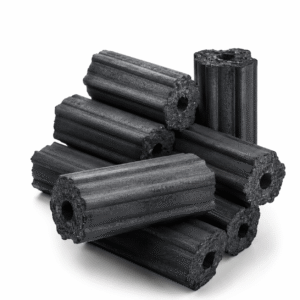
The distinctive hexagonal shape can make the product easy to stack, package, and handle. However, uniformity remains important because significant differences in dimensions may affect combustion and packaging efficiency.
- Consistent hexagonal shape
- Uniform length and diameter
- Clean edges and surfaces
- Minimal cracks and broken pieces
- Suitable dimensions for the intended application
4. Check Carbon Content
Carbon content is an important technical specification when evaluating fuel performance. A suitable carbon level can contribute to efficient combustion and stable heat output.
Ask suppliers for available product specifications or laboratory test results. Comparing technical data between samples can help buyers make a more informed purchasing decision.
5. Review Ash Content
Ash is the residue left after charcoal has burned. Lower and consistent ash levels are often desirable for cooking and grilling because they can reduce residue and cleaning requirements.
When comparing Hexagonal Charcoal Briquettes, review the stated ash specification and ask how quality testing is performed. Consistent results are important for repeat commercial orders.
6. Check Moisture Level
Moisture can affect ignition, burning efficiency, product weight, and storage stability. Briquettes should be properly dried and protected from excessive humidity throughout storage and transportation.
Export buyers should confirm moisture specifications before shipment. Proper packaging and dry warehouse conditions can further help preserve product quality after arrival.
7. Test Heat and Burning Time
Burning performance is often one of the most important purchasing considerations. Depending on the application, buyers may need stable heat, reliable ignition, or a long and consistent burning duration.
Request samples before committing to a large order. Testing Hexagonal Charcoal Briquettes under realistic conditions allows buyers to evaluate heat output, ignition behavior, and burning consistency.
8. Evaluate Smoke and Odor
Smoke and odor can strongly influence the user experience, particularly for restaurants, grilling businesses, and hospitality applications. Unwanted odor may indicate unsuitable raw materials, contamination, or inconsistent processing.
Sample testing provides a practical way to assess these characteristics. Buyers should compare products according to their intended application and target-market expectations.
9. Review Packaging
Good packaging protects Hexagonal Charcoal Briquettes from moisture, contamination, impact, and excessive breakage. Packaging should also be appropriate for warehouse storage and international transportation.
- Moisture-resistant inner packaging
- Strong outer cartons or bags
- Accurate net weight information
- Clear product labeling
- Suitable pallet and container loading
Discuss packaging specifications with the supplier before confirming an export order. Proper protection can help ensure that the product reaches customers in good condition.
10. Choose a Reliable Supplier
A dependable supplier should offer consistent quality, clear specifications, professional communication, and suitable production capacity. Do not evaluate suppliers based only on the lowest quotation.
Compare samples, quality-control procedures, lead times, packaging options, and export experience. A reliable supplier of Hexagonal Charcoal Briquettes can help buyers establish a more stable long-term sourcing relationship.
For additional product information and sourcing assistance, visit CV BERKAH WIJIL and explore the available charcoal solutions.
For general background information about charcoal, you can also consult Wikipedia as an external reference.
Key Quality Specifications to Compare
- Raw material and charcoal source
- Density and structural strength
- Shape and dimensional consistency
- Carbon and ash content
- Moisture level
- Heat output and burning duration
- Smoke and odor characteristics
- Packaging and shipping protection
Choosing quality Hexagonal Charcoal Briquettes requires attention to both technical specifications and practical performance. By checking each factor carefully, buyers can reduce sourcing risks and select fuel that better matches their commercial requirements.
For restaurants, distributors, retailers, and export buyers, consistent quality is the foundation of repeat business. A carefully selected product can provide dependable performance while supporting stronger customer satisfaction and long-term supplier relationships.
